
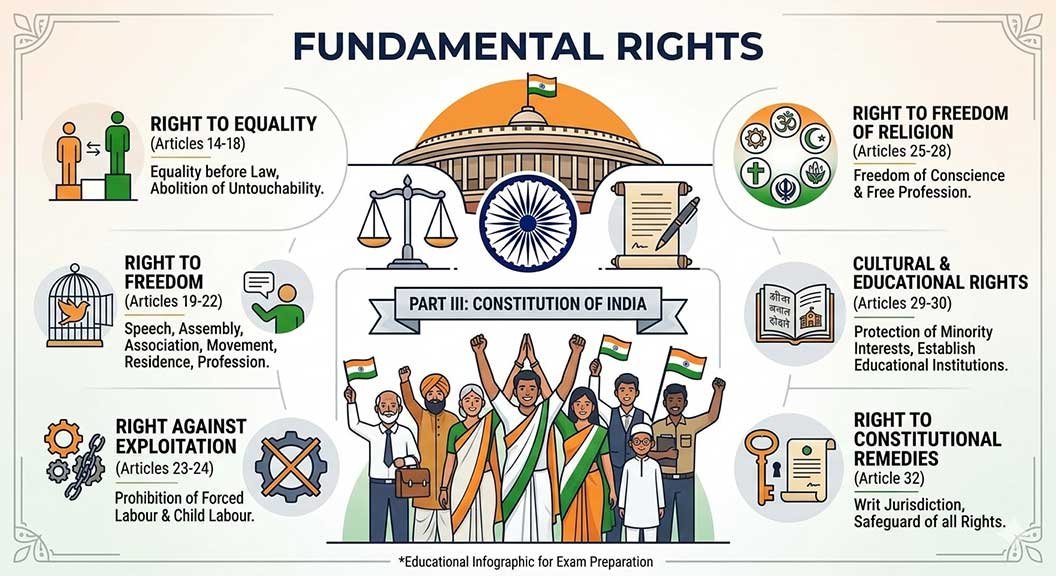
Fundamental Rights – Articles 12 to 35 Explained
The Fundamental Rights are one of the most important features of the Indian Constitution. They guarantee essential freedoms and protections to citizens and ensure that individuals can live with dignity and equality.
These rights are provided under Part III of the Constitution (Articles 12 to 35). The concept of Fundamental Rights was inspired by the Bill of Rights in the United States Constitution and aims to protect citizens from arbitrary actions of the state.
Fundamental Rights are considered essential for the functioning of a democratic society, as they protect liberty, equality, and justice.
Article 12 – Definition of the State
Article 12 defines the term “State” for the purpose of Fundamental Rights.
The term includes:
-
Central Government
-
State Governments
-
Parliament and State Legislatures
-
Local authorities
-
Other authorities within the territory of India
This definition is important because Fundamental Rights are enforceable mainly against the State.
Article 13 – Laws Inconsistent with Fundamental Rights
Article 13 declares that any law which violates Fundamental Rights shall be void.
This article establishes the principle of judicial review, allowing courts to examine laws and strike them down if they violate constitutional rights.
Right to Equality (Articles 14–18)
Article 14 – Equality Before Law
Ensures equality before law and equal protection of laws.
Article 15 – Prohibition of Discrimination
Prohibits discrimination based on religion, race, caste, sex, or place of birth.
Article 16 – Equality in Public Employment
Guarantees equal opportunity in government jobs.
Article 17 – Abolition of Untouchability
Declares untouchability illegal and punishable by law.
Article 18 – Abolition of Titles
Prohibits the state from conferring titles like “Rai Bahadur” or “Sir”, except military or academic titles.
Right to Freedom (Articles 19–22)
Article 19 – Six Fundamental Freedoms
Includes freedoms such as:
-
Speech and expression
-
Peaceful assembly
-
Association
-
Movement
-
Residence
-
Profession
Article 20 – Protection in Criminal Cases
Provides safeguards against arbitrary punishment.
Article 21 – Right to Life and Personal Liberty
Guarantees the right to live with dignity.
Article 21A – Right to Education
Ensures free and compulsory education for children aged 6–14 years.
Article 22 – Protection Against Arrest
Provides safeguards against arbitrary arrest and detention.
Right Against Exploitation (Articles 23–24)
Article 23 – Prohibition of Human Trafficking
Bans human trafficking, forced labour, and begar.
Article 24 – Prohibition of Child Labour
Prohibits employment of children below 14 years in hazardous industries.
Right to Freedom of Religion (Articles 25–28)
Article 25 – Freedom of Religion
Guarantees freedom to practice and propagate religion.
Article 26 – Religious Affairs
Allows religious institutions to manage their own affairs.
Article 27 – Freedom from Religious Taxes
No person can be forced to pay taxes for promoting a particular religion.
Article 28 – Religious Education
Prohibits religious instruction in certain government-funded institutions.
Cultural and Educational Rights (Articles 29–30)
Article 29 – Protection of Culture
Protects the language, script, and culture of minorities.
Article 30 – Minority Educational Institutions
Allows minorities to establish and administer educational institutions.
Right to Constitutional Remedies (Article 32)
Article 32 allows citizens to approach the Supreme Court directly if their Fundamental Rights are violated.
The court can issue five writs:
-
Habeas Corpus
-
Mandamus
-
Prohibition
-
Certiorari
-
Quo Warranto
Dr. B. R. Ambedkar called Article 32 the “heart and soul of the Constitution.”
Articles 33–35 – Parliament’s Powers
These articles allow Parliament to modify or restrict Fundamental Rights in certain situations, particularly for members of the armed forces and security agencies.
They also empower Parliament to enact laws for implementing Fundamental Rights.
Importance of Fundamental Rights
Fundamental Rights play a crucial role in protecting citizens from injustice and ensuring democratic governance.
They help:
-
Maintain equality and liberty
-
Protect minorities
-
Prevent misuse of power by the government
-
Ensure dignity and freedom for individuals
Because of their significance, questions related to Fundamental Rights frequently appear in competitive examinations.
Exam Points
-
Fundamental Rights are in Part III of the Constitution
-
Covered under Articles 12 to 35
-
Article 14 – Equality before law
-
Article 19 – Six freedoms of citizens
-
Article 21 – Right to life and personal liberty
-
Article 21A – Right to education
-
Article 32 – Constitutional remedies
-
Dr. Ambedkar called Article 32 the heart and soul of the Constitution
Summary
The Fundamental Rights (Articles 12–35) are the backbone of the Indian Constitution and protect the freedom, equality, and dignity of citizens. These rights ensure democratic governance and provide legal protection against arbitrary actions of the state. Understanding these rights is essential for competitive exam aspirants as they form a significant part of Indian Polity questions.