
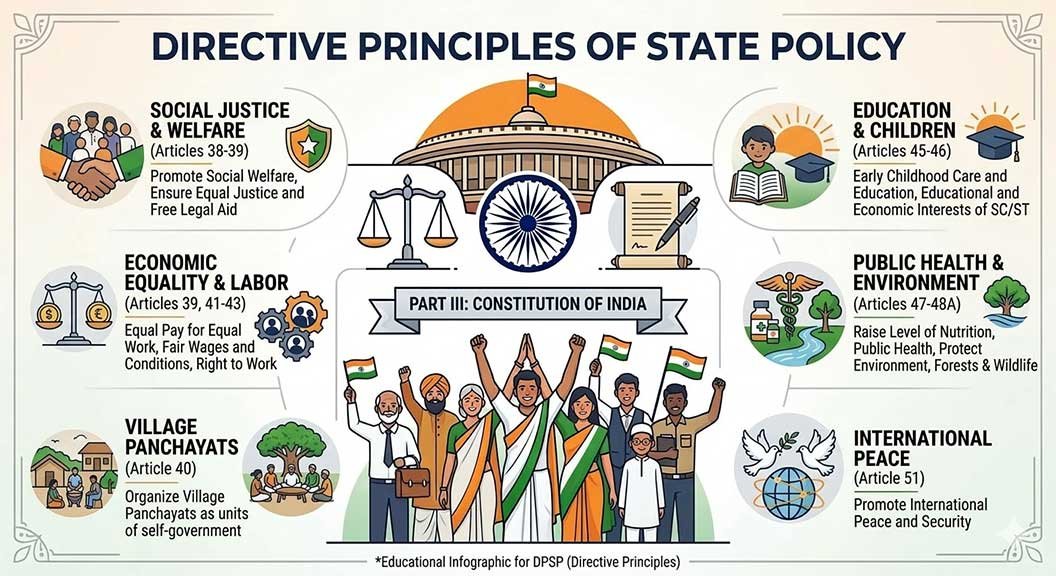
Directive Principles of State Policy – Articles 36 to 51
The Directive Principles of State Policy (DPSP) are contained in Part IV (Articles 36–51) of the Indian Constitution. They are guidelines for the government to establish a welfare state.
Article-wise Explanation
Article 36 – Definition of State
Defines “State” similar to Article 12.
Article 37 – Nature of DPSP
Not enforceable by courts but fundamental in governance.
Article 38 – Social Order
Promotes social, economic, and political justice.
Article 39 – Principles of Policy
Ensures:
-
Equal livelihood opportunities
-
Equal pay for equal work
-
Prevention of wealth concentration
Article 39A – Free Legal Aid
Provides free legal aid and ensures justice for all.
Article 40 – Panchayati Raj
Organization of village panchayats.
Article 41 – Right to Work
Right to work, education, and public assistance.
Article 42 – Just and Humane Work Conditions
Provides fair working conditions and maternity relief.
Article 43 – Living Wage
Ensures living wage and decent standard of life.
Article 43A – Workers Participation
Participation of workers in management of industries.
Article 44 – Uniform Civil Code
Promotes common civil laws for all citizens.
Article 45 – Early Childhood Care
Free education for children.
Article 46 – Weaker Sections Welfare
Protection of SCs, STs, and weaker sections.
Article 47 – Public Health
Improvement of nutrition and public health.
Article 48 – Agriculture & Animal Husbandry
Modernization of agriculture.
Article 48A – Environment Protection
Protection of environment and forests.
Article 49 – Protection of Monuments
Preservation of national monuments.
Article 50 – Separation of Judiciary
Separates judiciary from executive.
Article 51 – International Peace
Promotes international peace and security.
Exam Points
-
DPSP → Part IV
-
Articles → 36 to 51
-
Not enforceable
-
Based on Irish Constitution
-
Key Articles → 38, 39, 39A, 44, 48A
Summary
DPSP ensures social and economic democracy and guides the government in policy-making.