
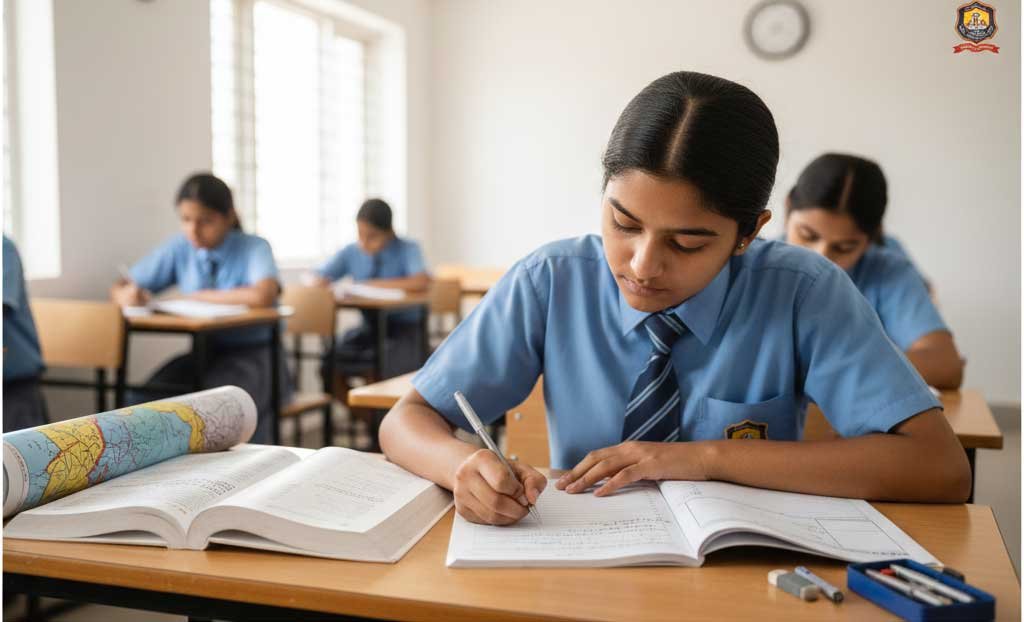
Complete Guide to ICSE Board
The Council for the Indian School Certificate Examinations (CISCE) conducts the Indian Certificate of Secondary Education (ICSE) examination at the end of Class 10. ICSE emphasizes strong English, detailed subject understanding, analytical answers, and project-based assessment.
1) What Is ICSE?
ICSE is a national-level board examination conducted by CISCE. It is known for:
-
Strong foundation in English language
-
Detailed syllabus structure
-
Balanced focus on arts and sciences
-
Emphasis on descriptive and analytical answers
It is widely recognized in India and abroad.
2) Structure of ICSE Class 10 Examination
Students typically study:
-
English (Compulsory)
-
Second Language
-
Mathematics
-
Science (Physics, Chemistry, Biology)
-
Social Science (History, Civics, Geography)
-
Optional subjects (Computer Applications, Economics, etc.)
The exam includes:
-
Theory papers
-
Internal assessments
-
Practical exams (for Science subjects)
3) Key Features of ICSE Pattern
✔ Strong English Component
English is mandatory and carries significant weightage.
✔ Detailed Subject Content
ICSE syllabus often goes deeper into explanations compared to other boards.
✔ Internal Assessment
Project work and practical records contribute to final grades.
✔ Analytical Answer Writing
Students must write structured, well-explained answers rather than short objective responses.
4) Subject-Wise Preparation Strategy
📘 English
-
Focus on grammar precision
-
Practice essay writing
-
Analyze literature characters and themes
🔬 Science
-
Understand concepts clearly
-
Practice diagrams neatly
-
Solve numerical problems step-by-step
🌍 Geography
-
Map work is crucial
-
Revise definitions and processes
🏺 History & Civics
-
Learn dates logically
-
Structure answers with headings
📐 Mathematics
-
Practice regularly
-
Solve previous year papers
5) Internal Assessment & Projects
ICSE places importance on:
-
Project work
-
Laboratory records
-
Class participation
-
Practical assessments
Students should not ignore these components.
6) Is ICSE Difficult?
ICSE is considered academically rigorous due to:
-
Detailed syllabus
-
Strong language requirements
-
Analytical writing expectations
However, with consistent preparation and structured study habits, students can score high marks.
7) ICSE vs CBSE – Quick Comparison
| Feature | ICSE | CBSE |
|---|---|---|
| Language Focus | Strong English | Balanced |
| Question Style | Descriptive | More MCQ + Competency |
| Internal Assessment | Significant | Moderate |
| Depth of Content | Detailed | Concept-based |
8) How to Score High in ICSE
✔ Focus on English proficiency
✔ Practice structured answer writing
✔ Complete project work sincerely
✔ Solve past 5–10 year papers
✔ Revise subject summaries regularly
Conclusion
The ICSE Board is known for its academic depth, language strength, and structured evaluation system. Students who develop strong conceptual clarity, writing skills, and disciplined study routines can perform exceptionally well.